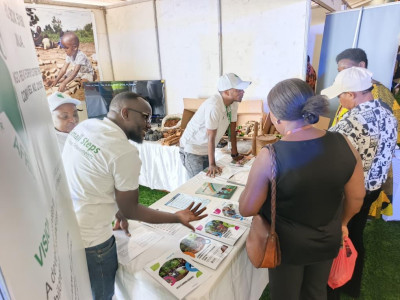
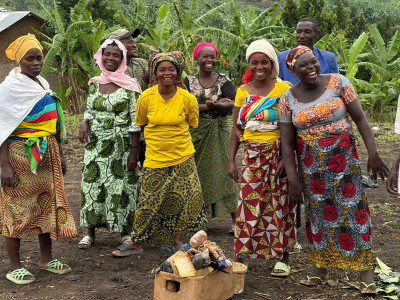
Hero Image

Written by Wardah Yusuf

August 23rd, 2026

This article takes 5 min to read

Under the tree: Introducing Early Childhood Education in Karamoja

Early Years Specialist Wardah Yusuf has been working in Kyaka II refugee settlement with Children on the Edge Africa for the past few years, developing child-led, play-based learning for Congolese refugee children. Recently, she and her colleagues have travelled to Karamoja, the poorest regions in Uganda, to introduce our ‘cluster learning’ model in remote rural communities. She shares reflections from her first visit.

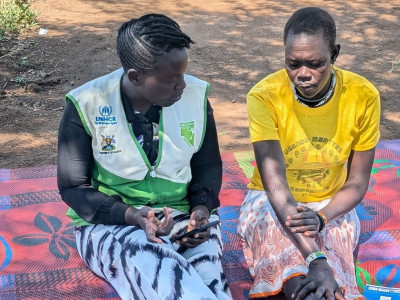
Wardah (front) talking to a community member in Karamoja

My first visit to Karamoja-Napak

Story time: In May 2026, I visited Karamoja to work alongside the team based there and help run community workshops about the importance of early years education. It was my first time going to Karamoja ( a 10-hour drive from Kyaka II refugee settlement where I currently work, and an  8-hour drive from Jinja where our head office is).

I was excited to visit, but had a lot of questions and was nervous about how it would go. I kept in mind that every child has a right to education and how important the first five years of a child’s life are for their development. 

Our first hurdle was reaching the communities, but overcoming these barriers only proved our commitment. The roads in Karamoja are poor, and on the way our car got stuck deep in the mud. Fortunately, some local contractors helped us get the car out and back on our way. 

"
The roads were hard, but our will to reach children was stronger.
"

As we reached the villages in Karamoja, there were no signs of any early years education happening. There were no play groups and no learning corners. I knew I had to think creatively to show the communities the  ‘power of early years education’ and start  conversations about the importance of early childhood education. 

What we found instead was something even more powerful: communities that were excited to hear from our team. They were engaged, enthusiastic and ready to bring learning to their children.

The reality: learning happens even without a classroom

As we visited different villages, we saw children who should be in school working, grazing animals. We also passed a family gathered around an anthill, parents and children together, collecting ants not as a game, but as part of daily life. It was then that I realised that though there is no formal education in place, learning is happening. Children are counting, sharing and problem-solving. Through doing, watching and being together, they are experiencing and learning. They need to have these everyday activities supported, made more intentional and to be given the freedom to play. 

We saw children sat around an anthill collecting ants

I worked with my colleague Mercy to engage the community and start conversations about why early years matter. We sat under a tree. Parents, elders, children - all gathered to listen. 

Mercy translated the session and really made it come alive. She turned big ideas about child development and playful learning into stories and songs the community understood. People were clapping, asking questions, and leaning in. 

"
We sat under a tree. Parents, elders, children - all gathered to listen.
"

For many, it was the first time they had heard that playing is learning. And that excitement taught me something I thought I already knew: people are different, and learning takes time.

During the workshop, I spoke about shelter and safe spaces for children. The community understood and responded immediately by collecting materials for shelter construction. They weren’t waiting for us to say ‘go ahead’; they were already excited to construct a safe space for their children. Elders, women, and men had gathered poles and thatch. No one told them to; they did it because they believe their children deserve a place to learn and play. 

That is real community ownership. That is hope.

Community members gathering materials to start building a shelter

Starting with surprise: playful learning

In the first workshop, I spent time talking about what playful learning looks like, and I asked the community members to bring some resources to the next session.

The next day, they brought bottle tops, sticks, and stones to use as teaching aids. The community members were surprised to see how effective simple local materials could be.

The most beautiful moment was watching the elders from the community collect teaching aids for their children. They were surprised to see how these simple items could be used to count, sort, and play.

They appreciated that we weren’t asking them to buy expensive toys. We were asking them to use what was already in their hands.

One mother held up red bottle tops and said, “So this is how my child can learn numbers?”

Yes. That’s exactly it. Playful learning.

Creative Solutions from the field 

As a project officer in Kyaka, I knew that the workbooks we use work well; partly because the teachers are familiar with school and more formal education settings. 

In Karamoja, there is nothing like school; so I suggested we start with the practical part of the workbooks -  let’s play, let’s talk, let’s try.” This method worked, so we put our heads together to come up with a solution to make the rest of the workbooks relevant and accessible for the communities in Karamoja. 

Community members in Karamoja trying one of the activities, using stones to count and make patterns on the ground

This is why the ‘Playful Learning Activity Book' was created. It was designed after working with the community to bridge the gap and meet the people where they are.

It’s a simple, visual booklet which shows teachers how a daily routine flows and what children are learning through different play-based activities.

Some community members have low levels of literacy, so whilst the playful learning booklet has been translated into the local language (a project in itself, as my colleague Mercy explains), there is no heavy text. Just clear pictures and routines a teacher can follow right away: greeting children, sitting in a circle, playing with stones, singing, and building.

It uses what the community already has: the ground, songs, play, low-cost or free local materials, and time together.

This is just the beginning. As teachers gain confidence and experience, we will introduce more workbooks, but first, we lay the foundation. This is the "why" behind play.

Little hands, big learning: The power of play

During the sessions and community visits where I interacted with children, their curiosity reminded me that every training session and every interaction is really for them. Talking to the children grounded me. Children don’t need complicated tools and expensive resources. They need time, love, and someone to play with them.

"Early learning is not done to communities; it’s done with them. Grateful to be on the ground in Karamoja."

Kneeling to work alongside my amazing team members based in Karamoja. Learning together, building together.

What Karamoja taught me: 

Karamoja taught me that inclusive education is not one-size-fits-all. A tool that works in one context must be adapted for another. The pace, the language, and the materials must respect the community’s reality. 

As we prepare to return for teacher training, I think back to my first visit - The excitement of the community, their questions, the bottle tops, the smiles, the handmade resources they created, and the community building with their own hands. 

It was fantastic to collaborate with team members whom I don’t work alongside so regularly. This highlighted the importance of having people like Mercy who know the people and can bridge language and culture. 

It reinforced the principles of listening first and believing that quality learning can start with what we have. At the end of the day, a building is not a school and a workbook is not learning. Understanding is, and understanding starts with patience, respect, and the joy of play.

A donation today can help children in Karamoja access vital play-based early childhood education.

Read more

Sign Up


Thank you!

Thanks for subscribing! Welcome to our Community. Keep an eye out for your first email from us.