Hero Image

Written by Judith Gallimore

March 26th, 2026

This article takes 8 min to read

How Congolese refugee communities have - quite literally - ripped up the rulebook on early years learning

I have just returned from spending two weeks in the Kyaka II refugee settlement in Uganda. As it is exactly three years since my first visit, I thought it was a great opportunity to reflect on our ‘cluster learning journey’. 

‘Cluster Learning’ is a community-led Early Childhood Education (ECE) model, specifically designed for marginalised refugee children in Uganda, but soon to be replicated in other situations. It involves small groups of children learning in local homes and community spaces, using play-based curricula led by trained local teachers, bypassing the need for traditional school buildings

I retired from teaching in August 2022, with the last 15 years working in early years learning. When I was invited to share good practice as a volunteer at Children on the Edge, it was perfect timing as they were just introducing cluster learning in Kyaka. I’ll talk you through the adventures of what has happened since!

Trip one - Counting to ten isn’t the goal we think it is

In April 2022, I travelled with Early Years Specialist Sarah Ndlovu from Children on the Edge to see how things were going and assess what was needed next. My initial response was one of amazement at seeing thousands of early years children meeting three times a week under trees in small groups with a teacher (known as a caregiver). 

A cluster learning group sitting with their teacher who is showing them pages from a workbook.

However, the more groups we visited, the more I realised that the children were just sitting in circles for most of the time and were being taught by rote. They were simply calling out a list of numbers “1,2,3,4,5,6,7,8,9,10”. At one point, I held up a number six on a board, asking the children to do six jumps, and they couldn't understand what I meant. They could count to 10, but had no understanding of what numbers actually meant. 

Likewise, considerable time was spent on the subject of people who helped me. The big red book came out, and the children repeated after the teacher, “My father is a dentist” - many times! I turned to Sarah, enquiring if they had been to a dentist or even knew what a dentist was. It was very clear that cluster learning had to become play-based and child-led. So, the communities supported by Children on the Edge started the journey to achieve this. 

Trip two - Building play stations

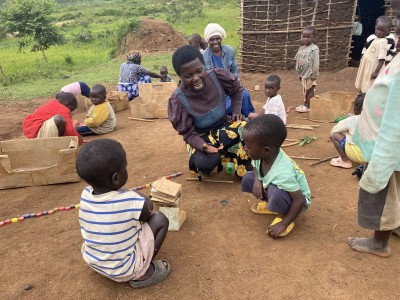
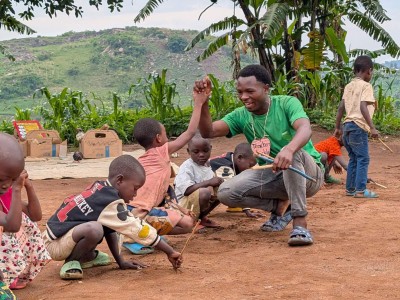
By the time I went back in September 2024, Children on the Edge had been working with the local communities here to create workbooks based on the Ugandan curriculum for early years children. I arrived during the children's holiday to provide a week of training for the programme’s group of teacher trainers.  Using local resources (sticks, sawdust, bottle tops, bottles, etc.), we created ‘play stations’ to introduce the idea of play-based learning. Everyone was eager to learn. Time was needed to embed their new approach, and as always, lots of action plans were put in place for us to help and support them. 

One specific area in which I could help was refreshing the workbooks. For a start, with few teachers reading English, they needed to be translated into Swahili. They also needed to be made more culturally relevant. For example, why use ‘a for apple’ when it’s very unlikely a child will have seen an apple in Kyaka; however, ‘a for ants’, of which there are a lot, was a great substitute! It was also essential that the timetables in the workbooks gave over half of the time to play-based learning, to discovery time and physical fun, all child-led. 

My last trip - Ripping up the rulebook

So it’s February 2026 - three years since my first visit to Kyaka - and I am delighted to say that play-based learning here has improved beyond recognition. The children are playing, they have a voice, and real learning is happening.

I often talk about ‘every minute being learning time’, and wow, it is! Each morning, we visited the study areas, of which there are now 42 across 10 zones of the refugee settlement, with around 4,500 children now benefiting from cluster learning. 

"
It made me chuckle to see our original workbooks actually ripped up and used as materials for child-led, free play building instead!
"

One noticeable difference was just how much this programme is now owned and supported by the communities. Through parent involvement and local savings groups, the work has become sustainable and, so shock-proof, that it is the only early years work in Kyaka that has survived this year’s brutal funding cuts from USAID. One great example I saw was that the communities in each area had built three mud classrooms for each of the groups, enabling learning to continue throughout the rainy season. 

As expected, we saw study centres at various stages of development. My visit had purposefully created space each afternoon to reflect on our visits with the team and adjust the teacher trainer learning accordingly. Four days of training allowed us to look at the importance of cognitive development and where we find it in the workbooks as well as in the study groups. We learnt about the importance of interactions and quality sustained listening. Opportunities were created to weave all these ideas into the play sessions we created, which helped us answer what a play-led environment needs to look like. 

Obviously, the abundance of ‘recycled’ materials is essential to create meaningful play, but so are the quality interactions that the teacher provides each child. We ensured a very hands-on approach to training. We had sessions on ‘peer learning’, observing our weaker teachers and how we could help them develop, we looked at engaging community members and parents, safeguarding, and how we make sure our study areas are inclusive to all children, whatever their individual needs are. 

As I reflect on the visit, I am encouraged that the training we all did together means that the Children on the Edge Africa team is in a strong position to keep improving as well as filling gaps that have been identified. They have ‘Model Study Areas’ to create examples of best practice for areas that are struggling, weekly teacher observations, bi-weekly peer learning and continuous work with our Community Member Committees, who are the backbone of the programme. It was wonderful to work with Christian Niyonsoba, a Congolese refugee himself who is highly qualified in early years work, and one of our best teacher trainers. He will soon be leading the team, and I’m excited to see play-based learning grow even stronger as a result.

An afterthought - when crisis is the context

I can’t share my experiences and miss out the fact that there were moments of sadness too. I have certainly asked myself many times, ‘What will it really be like in a year?’ USAID cuts have had a huge impact. Kyaka was really developing, but now there are signs of decline with businesses closed, offices abandoned, and everyone clearly struggling. This became very evident in our safeguarding training as we struggled to identify who is actually left to receive referrals. 

However, there is hope. This is a community of people who have already faced many hardships in life and have learnt through experience to be resilient. The community is desperate for their children to succeed, and they have embraced a play-based approach to helping their children learn and become ready for school. Cluster learning is such an easy and effective way of creating children who are school-ready. By using a lot of sticks, bottle tops, banana leaf skipping ropes, balls and dolls, play-based learning will help create eager learners who are resilient and better prepared for an uncertain future.

Read more

Sign Up


Thank you!

Thanks for subscribing! Welcome to our Community. Keep an eye out for your first email from us.