Rohingya boy carrying bamboo frame against backdrop of sprawling refugee camp

UN court holds Myanmar accountable for Rohingya genocide - why education remains critical

Children on the Edge welcomes the news that the UN’s top court has found Myanmar's ruling military junta responsible for genocide against its Rohingya minority. This historic judgement marks the first time the International Court of Justice (ICJ) has held a state accountable for genocide in its 80-year history. This is a landmark moment for a community we have stood alongside in Bangladesh since 2009, supporting Rohingya refugee children to access quality education and rebuild their futures.

On 19th November 2026, Myanmar was found responsible by the International Court of Justice (ICJ) for violations of the Genocide Convention against the Rohingya during their 2016-2017 military ‘clearance operations’ in Rakhine State near the Bangladesh border.

International Court of Justice Rohingya Genocide ruling

In a case brought by the Gambia seven years ago, the court has now ruled that Myanmar’s military purposefully carried out a campaign to exterminate and expel the nation’s Rohingya population, resulting in the killing of over 10,000 innocent Rohingya, along with widespread sexual abuse and inhumane acts of violence against children. In a carefully coordinated effort, soldiers firebombed Rohingya-majority settlements and targeted the fleeing civilians. The ICJ also noted that the junta’s generals subsequently attempted to destroy evidence of these crimes. The ruling is final and cannot be appealed.

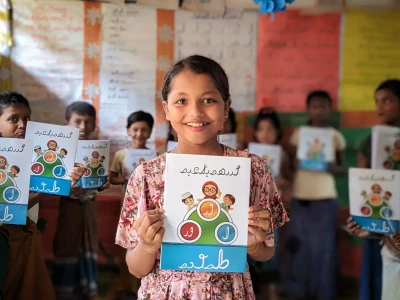
Group of Rohingya children hold up Hanifi textbooks and smile

Children on the Edge

Children on the Edge and the Rohingya

Children on the Edge has worked alongside the Rohingya community in Bangladesh since 2009, long before the crisis made global headlines.

In 2010, we were one of only three organisations working in the makeshift Kutupalong camp, where unregistered Rohingya refugees were cut off from basic services. At the community's request, we responded to the lack of children’s education, providing award-winning, locally led, low-profile classrooms for around 3,000 learners each year.

In August 2017, the Myanmar military’s genocidal campaign forced over a million Rohingya refugees across the border into Bangladesh. The majority arrived directly into the areas where we were already working. Because our relationship with the Rohingya community was firmly established, we were uniquely placed to offer immediate humanitarian support, rapidly pivoting into emergency relief and doubling our classroom capacity to absorb newly arrived, traumatised children.

Rohingya girls in a mud room sit in a line and discuss their school text books.

Children on the Edge

Pivoting Children on the Edge learning centres for thousands of arriving Rohingya refugee children in 2017

As Kutupalong swelled into the world's largest refugee settlement and hundreds of organisations arrived, meaningful education remained out of reach for Rohingya children. Bangladesh is already one of the world’s most densely populated countries and, fearing further Rohingya integration, the government restricts refugees from learning Bengali and insists on the use of the Myanmar government’s Burmese-language curriculum in all refugee camp schools. 

After generations of exclusion from education, virtually all Rohingya children and their teachers are unable to understand the Burmese language in their textbooks. To mitigate this, after a few years of bridging the gap with dubbed video lessons, Children on the Edge is pioneering Mother Tongue-Based Learning for the Rohingya. 

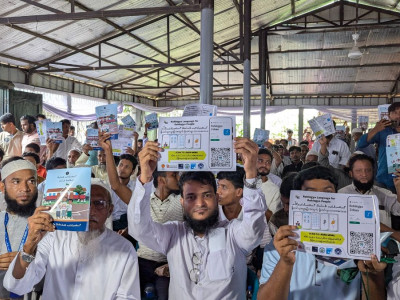
After seeing an 82% improvement in exam results through our pilot, the government approved the expansion of Mother Tongue-based learning to 4,000 more Rohingya children in the camp. Children on the Edge is now making this proven model open-source, engaging with the sector with the goal that every child in Kutupalong can access meaningful learning in their own language.

Rohingya refugee boy holds up Hanifi script learning poster

Children on the Edge's mother-tongue literacy curriculum enables Rohingya children to achieve foundational reading and writing skills in just 6 to 8 weeks.
What next for the Rohingya? 

After the November 2026 ICJ ruling, we continue to stand with the Rohingya community. We urge Myanmar authorities to honour the court's orders by allowing and facilitating the safe, voluntary, and dignified return of displaced Rohingya, aiding family reunification, prosecuting suspects, and providing adequate compensation.

With a lack of meaningful education in Kutupalong, school attendance is dropping, leaving children at risk of child labour, child marriage, trafficking and recruitment into the growing number of organised crime gangs and violent fundamentalist groups in the camps. We will continue to work with our partners, Mukti Cox’s Bazar and the Bangladesh government, to realise every Rohingya child’s right to access quality education and to thrive.

For more information or to book a spokesperson, contact Esther Smitheram by emailing esthersmitheram@childrenontheedge.org or calling 01243 538530.

Sign Up


Thank you!

Thanks for subscribing! Welcome to our Community. Keep an eye out for your first email from us.