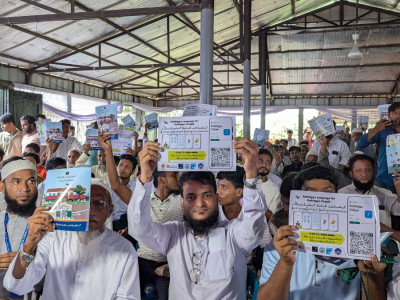
A group shot of some of the teachers in Kutupalong
Esther Smitheram

Written by Esther Smitheram

October 5th, 2026

This article takes 6 min to read

Standing With Rohingya Teachers - ‘Words That Land’ in Kutupalong Camp

During a day of discussions with Rohingya teachers in Kutupalong refugee camp this summer, a single concept continued to surface. If you take away a child's language, you take away their ability to learn.

Teacher training in Bangladesh
Observing Mother-Tongue Pedagogy in Kutupalong

In June I visited Bangladesh with doctoral researcher Rachel Robinson from the University of Oxford. She was observing a Children on the Edge mother-tongue language programme for Rohingya refugee children in Kutupalong refugee camp as part of the GARJE programme, supported by the University of Bristol and Action Aid. 

We went to analyse the pedagogy and look at anti-racist education in practice. Children on the Edge is a small organisation that draws on over 35 years of experience to co-create, test and develop models of best practice to share with larger organisations and governments. In its pilot phase, children who learned in Rohingya achieved a 78% pass rate compared to those in the control group. Since then, we received permission to expand to all our classrooms, reaching over 4,000 Rohingya children. These 4,000 may be a drop in the ocean when considering the remaining 330,000 children in the camp, but the goal is for the mother-tongue education model to be adopted by the wider education sector and shared throughout all classrooms.  

Esther and Rachel standing with teachers in a classroom in Kutupalong

Esther Smitheram and Rachel Robinson with some of the teachers in Kutupalong

Talking to students, parents and teachers about its impact so far, we were struck by the change that can happen when a community is free to embrace its own language. This year’s official theme for World Teachers Day focuses on standing with teachers to protect the profession, advance its status, and shape the future of education. We could see that in practice as we visited several classrooms in Kutupalong.

Help bring classrooms alive with Mother-tongue learning.

A donation today could help refugee children in Kutupalong learn to read and write using the Rohingya language.

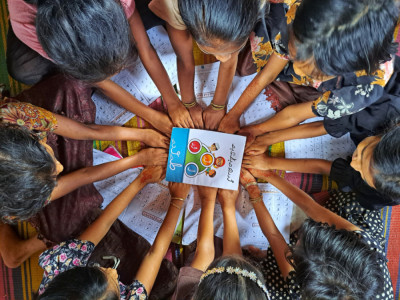
children smiling in class holding up their Rohingya language textbooks

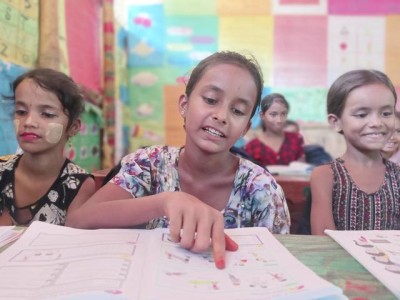
Historically, Rohingya has been an exclusively spoken tongue, with no universally accepted script, but using the new curriculum from Children the Edge, Rohingya teachers were conducting lessons entirely in their own language.  I had visited classrooms before, but during this trip I was able to sit through full lessons and see the calibre of the teaching. Teachers like Moni Ara and Yeasmin Akter used high-energy verbal and visual methods to embed phonics before the children even touched a pencil. It was fully interactive, the atmosphere was buzzing and the children were completely immersed. 

Teacher smiling with her hands up in the air at the front of class

We also spent time with a group of Rohingya teachers who had advanced training on the programme. We talked about their experiences teaching in their own language as adults, what this practice was like when they had to use Burmese, and what their own childhood learning experiences showed them about the importance of mother-tongue learning.

Sitting in Silence

We heard that learning in a language you do not understand is an exhausting, isolating experience. Watching us struggle to follow untranslated stretches of discussion throughout the workshop brought back vivid memories for the teachers.

"
What you are going through right now is what it was like for us as children. We just sat in a room where people were talking in a foreign language.

Shofi
"

Teacher Shofi

Even before they fled to Bangladesh following the 2017 genocide, for generations in Myanmar, the education system has barred Rohingya teachers from the classrooms. In the rare situation where Rohingya children were allowed to learn, they were left to figure out lessons on their own.

Shah Alam (Head Teacher): "All our schools had Burmese teachers. They didn't speak Rohingya themselves, so even if they had wanted to try and explain to us Rohingya, they wouldn't be able to."

Moni Ara: "I had a Burmese teacher as a child; I tried and tried but failed to understand, and I simply lost motivation to learn. Now I see that the children can learn just like I wanted to; they have that motivation, and I am a part of it."

Children sat at desks with their hands up in the air

Translation creates a triple-stage process in learning

Before Children on the Edge introduced Rohingya language lessons, learners had to navigate a complicated three-stage translation process just to understand a basic concept: taking an English word, matching it to Burmese spelling with English pronunciation, and then trying to convey the actual meaning. This mental gymnastics drained energy for both teachers and students.

three stages of translation from Burmese

An example of the three-stage translation process

Moni Ara: "The children used to be nervous coming into school, because everything they learned the day before was a blank. The thing is that the teachers felt the same; my mind would be a blank coming into the lesson too."

Removing that barrier has freed teachers to move beyond translation and focus entirely on delivery and depth.

Foyaz: "We are now comfortable in our lesson planning. Before, all the time was spent translating, and then the concepts were not clear in our heads, and we didn't have room to contribute anything further to the plan."

"
Words do not land in another language.

Sadeq
"

Teacher Sadeq

Children’s own language, children’s own voices

When children learn in a language that is not their own, they rely on memorisation, and much of this education is passive. However, when they learn in their native tongue, concepts stick and they begin to learn through interaction and self expression. They engage naturally with the world around them through reading and writing. We heard how Rohingya children are now writing shopping lists when they go to market for their mums, teaching their parents and siblings, and writing letters to each other. It’s opened up creativity in lessons for the teachers too.

Sadek: "I love storytelling. They can come alive now that they don't have to be translated. The stories come alive and are captivating for the children."

Moni Ara: "I love that I can write about myself now. I did some writing about myself in class, and the children immediately wanted to do the same. They can communicate richly, with more details and memories."

Sayed: "My best moment was during a Rohingya language lesson about animals; I realised the children were easily using real descriptors, and I didn't need to translate any of the meanings."

Teacher at the back of class talking to a student

Mother-tongue learning brings classrooms alive

Teachers explained how, now children understand what is being said, their nervousness is disappearing, and staff no longer have to do home visits to chivvy anyone along to school.

Shah Alam (Head Teacher): "I don't have to do home visits anymore; the attendance has just gone up. Children are interested and present."

Gultas: "I can see they remember each detail now: sentences, words and clauses."

Shofi: "The children can write notes. It's essential to learning."

Standing with teachers means giving them the tools, status, and recognition to teach effectively. On World Teachers Day, these educators are showing us what that can look like. We can see clearly that they are rebuilding confidence, preserving a Rohingya culture under threat, and giving a generation of children the right to understand their own education. They deserve our support.

Foyaz: "I want to change my community through the Rohingya language, and show the world the Rohingya language."

Help bring classrooms alive with Mother-tongue learning.

A donation today could help refugee children in Kutupalong learn to read and write using the Rohingya language.

Teacher smiling with her hands up in the air at the front of class

Sign Up


Thank you!

Thanks for subscribing! Welcome to our Community. Keep an eye out for your first email from us.