The future of Rohingya learners, both in Kutupalong and around the world, depends on creating an education system that values their rich language and cultural heritage. Learning, here, is not only about imparting knowledge – it is about supporting a sense of belonging, agency and the possibility of futures not defined by displacement.
There is reason for hope. In the 1980s, a Rohingya scholar, Mohammad Hanif, developed a written script – called Hanifi – for the Rohingya to allow people to express themselves in their own language and support more meaningful learning. Now, Muhammad Noor, a Rohingya social campaigner and founder of the Rohingya Language Council, has created a Unicode-approved Hanifi Rohingya font to support the wider use of written Rohingya, including in textbooks, websites, and other learning materials. This is having a profound impact in promoting home language education for Rohingya refugees in Bangladesh and beyond.
Noor’s inspiring vision to preserve and promote the Rohingya language is an act of resisting and refusing cultural genocide. This was a driving theme of a recent exhibition and discussion event, ‘Learning in Exile’, held at the Wiener Holocaust Library in London, which we reflect on in this short piece.
Cultural genocide refers to the intention to eliminate or assimilate a group’s symbols, institutions and expressions of identity. As scholars have argued, for all its transformative possibilities, education has been complicit in cultural genocide; education has been used by colonial and post-colonial states to systematically deny and replace a group’s cultural knowledge. The restriction or banning of a group’s language is one way in which cultural genocide can be perpetrated, given that it prevents the transmission and reproduction of culture and heritage to future generations.
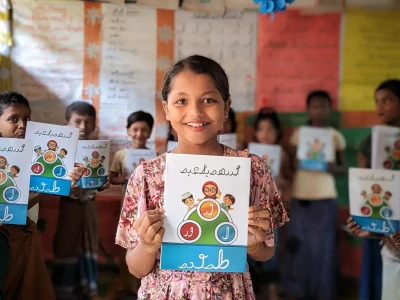
During the Learning in Exile exhibition and discussion, Mohammad Noor explained the impact of cultural genocide against the Rohingya and how his advocacy and innovation are actively resisting it by creating new educational infrastructures for Rohingya language and cultural learning. His creation of the Rohingya Hanifi Unicode font has enabled Rohingya-language textbooks to be written and used in schools in Kutupalong. The Rohingya-Hanifi digital keyboard has enabled Rohingya of all ages across the world to communicate with each other in their home language through computers and mobile devices.
Digitising the Hanifi script is a part of a larger vision to refuse the cultural genocide against the Rohingya. Noor is working on creating a digital platform for stateless Rohingya, using the Hanifi script to: document and archive community histories and cultural knowledge; create Rohingya language learning opportunities and educational capacity building; and build a platform for Rohingya across the world to exchange knowledge and resources – sustaining communities into the future. Across this important work is the recognition, promotion and teaching of the Rohingya language that is so crucial to supporting linguistic justice in education.